Introducing Cobbler 👋
An app 17 years in the making...
…I mean it though! It’s not like those awful about pages where it’s touting a small studio's 100+ years of combined experience… (don’t get me wrong, I’m guilty of using this device still to this day… [sidebar—how is DGMW not a thing yet?]). But no, really, this is something that we have actively been building for nearly seventeen years. That’s a long time to be doing something, so I felt it deserved a long post, so here we go.
Firstly, though, ✨🔮🤍 Welcome to my Substack!!! 🤍🔮✨. I know there are lots of problems with this site, but it also seems the best place to do what I need to do, so it’ll have to to do, for now. Doo-ee-doo.
Immortality Projects is me, Jeremy Wortsman, and a rotating cast of software designers and developers. I bought the domain name many many years ago after reading this book. Only to learn it was ripped off from this book. I do love buying a good domain and I've almost used all of the random ones that I've been mindlessly renewing each year. (Except for one last one that is just waiting in the wings...)
IP is an independent operation outside of my work with Jacky Winter which will house my growing portfolio of forays into software development. Cobbler will reside there, alongside our other products such as PencilBooth and Replier.
My plan at the moment is to post general work-related thoughts and updates every month or so, maybe more. Most posts like this will probably be much longer than they need to be, because I'm a terrible editor.
While I have a very checkered past of blogging with any sort of consistency, I do think I have a few interesting things to share, like an account of my wayward days in the ANSI art scene of the early 90’s, to our efforts in the AI space and my learnings on hiring and culture. While I find the act of writing intensely painful and horrible, I am making more of an effort to do it.
So first off, for all of you who are wondering what Cobbler is and just want the tl;dr, here’s the website, go on and let your fingers do the walking and go to cobbler.app
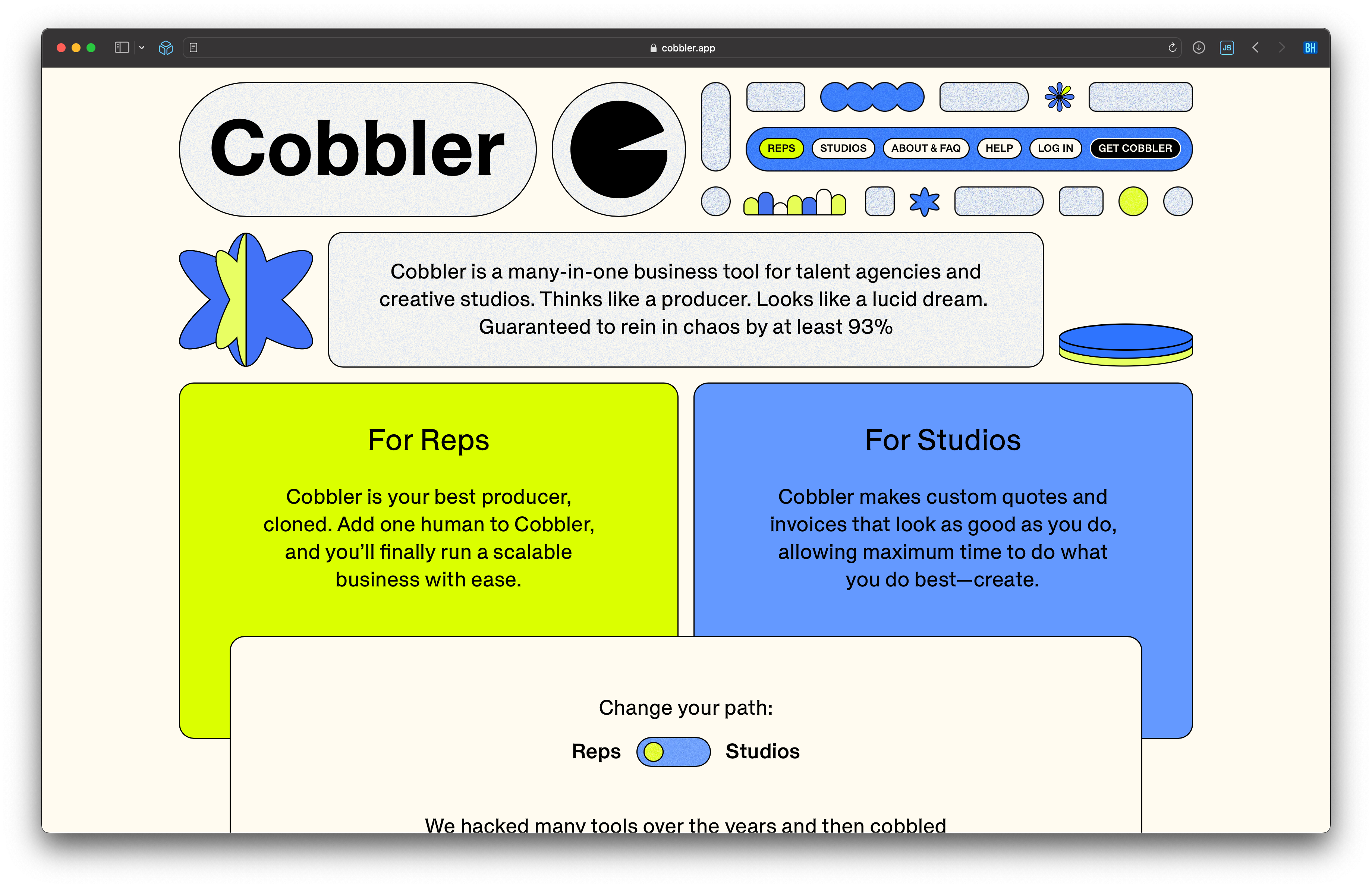
For everyone else still here (or probably just my parents, really), here’s a bit more background on how this all came to be:
(insert flashback gif here)
When I started Jacky Winter in late 2006, I was still running the graphic design studio Chase & Galley with my fellow Is Not Magazine co-founder and BFF, Stuart Geddes. The original idea behind Jacky Winter was to give Australian artists the chance to ‘take-flight’ by essentially me marketing them to my friends back home in the US who were now starting their own careers as Art Directors and Designers.
To that end, it was really important that every interaction with Jacky Winter was also designed well. We were talking to and selling to Designers, and I wanted to ensure we were all speaking the same language, visually at least.
Now back around this time, online tools for quoting and invoicing were pretty much non-existent. Xero had only just started that year, and most bookkeeping and invoicing was done offline using an app called MYOB. So for the first year of Jacky Winter, everything was just done in Indesign. One file. One locked layer. Lots of duplicating and renaming files. It was a mess, but it was my mess. And it looked gorgeous, because I got to use my fonts!
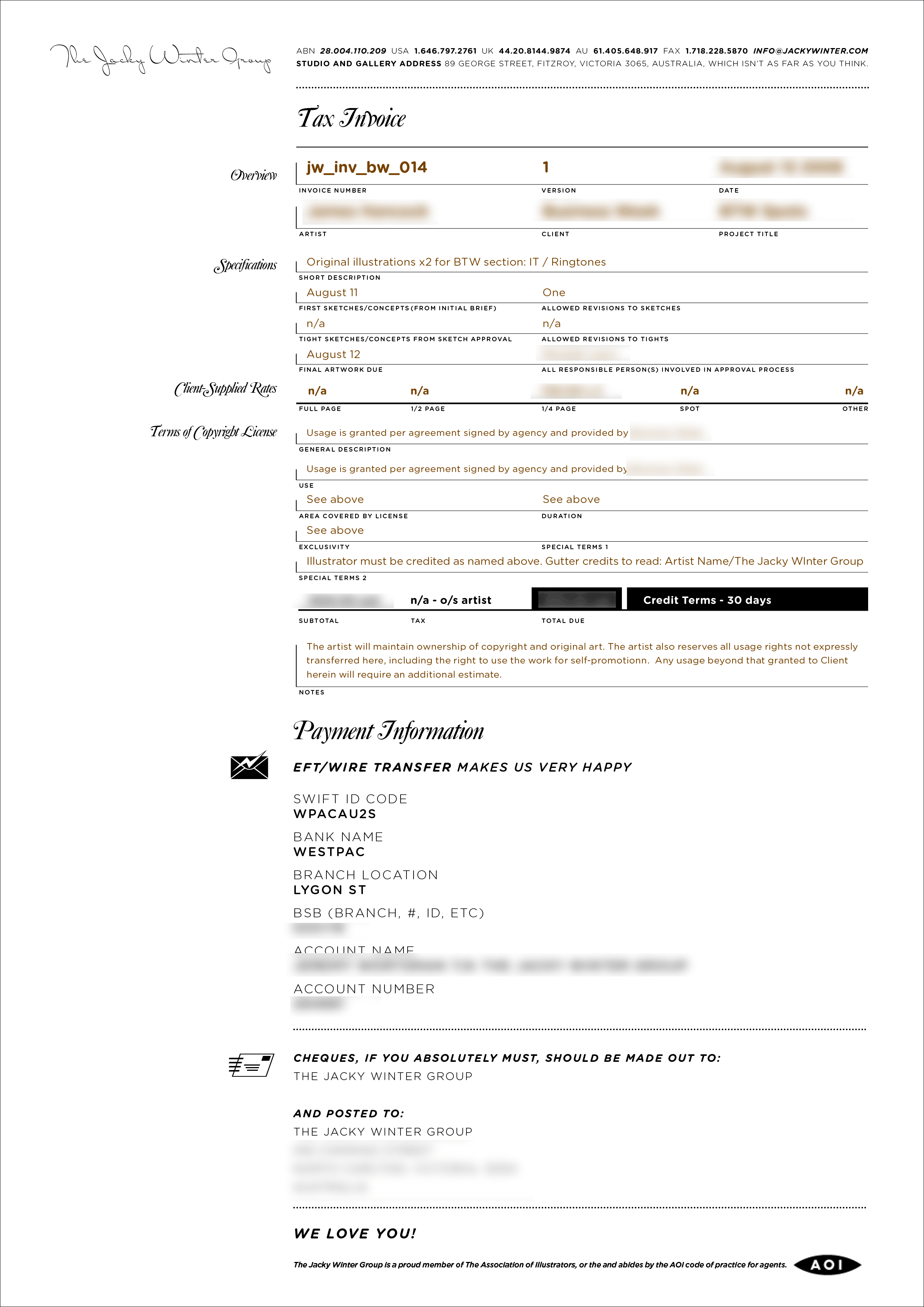
That said as things grew I was determined to do something different and find a better way to automate things. I remember from my experience working and freelancing in-house at many design studios and ad agencies that most of these companies had their own weird proprietary app (that most people hated) built on this platform called FileMaker Pro, along with the required and highly coveted ‘FileMaker Guy’ who we’d always have to call to fix something.
Now, FileMaker is a super interesting tool. It’s still very much alive and kicking today, and in fact it’s one of the few software companies that is owned by Apple that still operates as its own brand. At its core, FileMaker is a database program that can make very simple and flexible apps, but there are very few people who know how to use it. So I went on the FileMaker site, looked up who our local experts were, and after a few emails I managed to find one Byron Stone of Datamine.
You know how sometimes you meet someone and either just instantly get along with them or just instantly get off to the wrong foot? Byron was one of those guys who was just so nice, accomodating, and smart right off the bat. But also he was a fellow American, which usually can go either way, but I think I was particularly homesick at the time and we really just clicked.
Anyway, after a meeting with Byron, I finally had my own ‘FileMaker Guy’, and in a few months he mocked up our very own app. At first it was very simple - We took the base layers of those indesign files and made them into PDFs that made the background. Then when we entered data into FileMaker, it would ‘print’ it on top of the PDF base and make a new PDF which we could email off to our clients. We could even use my precious fonts! In addition we were able to have a central record of all our jobs, could make revisions of the estimates, start building a database of clients and artists, do reports, a whole bunch of stuff.
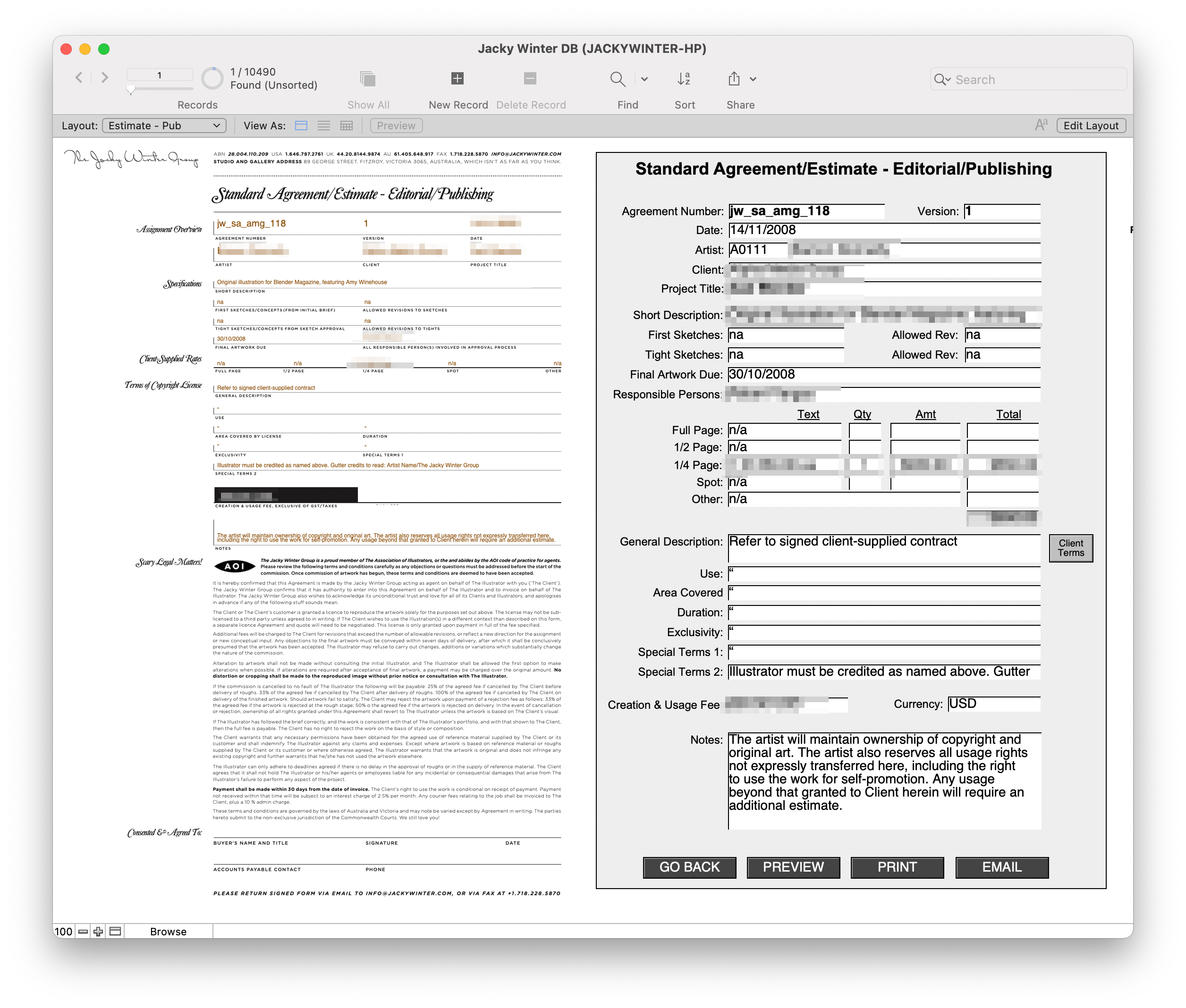
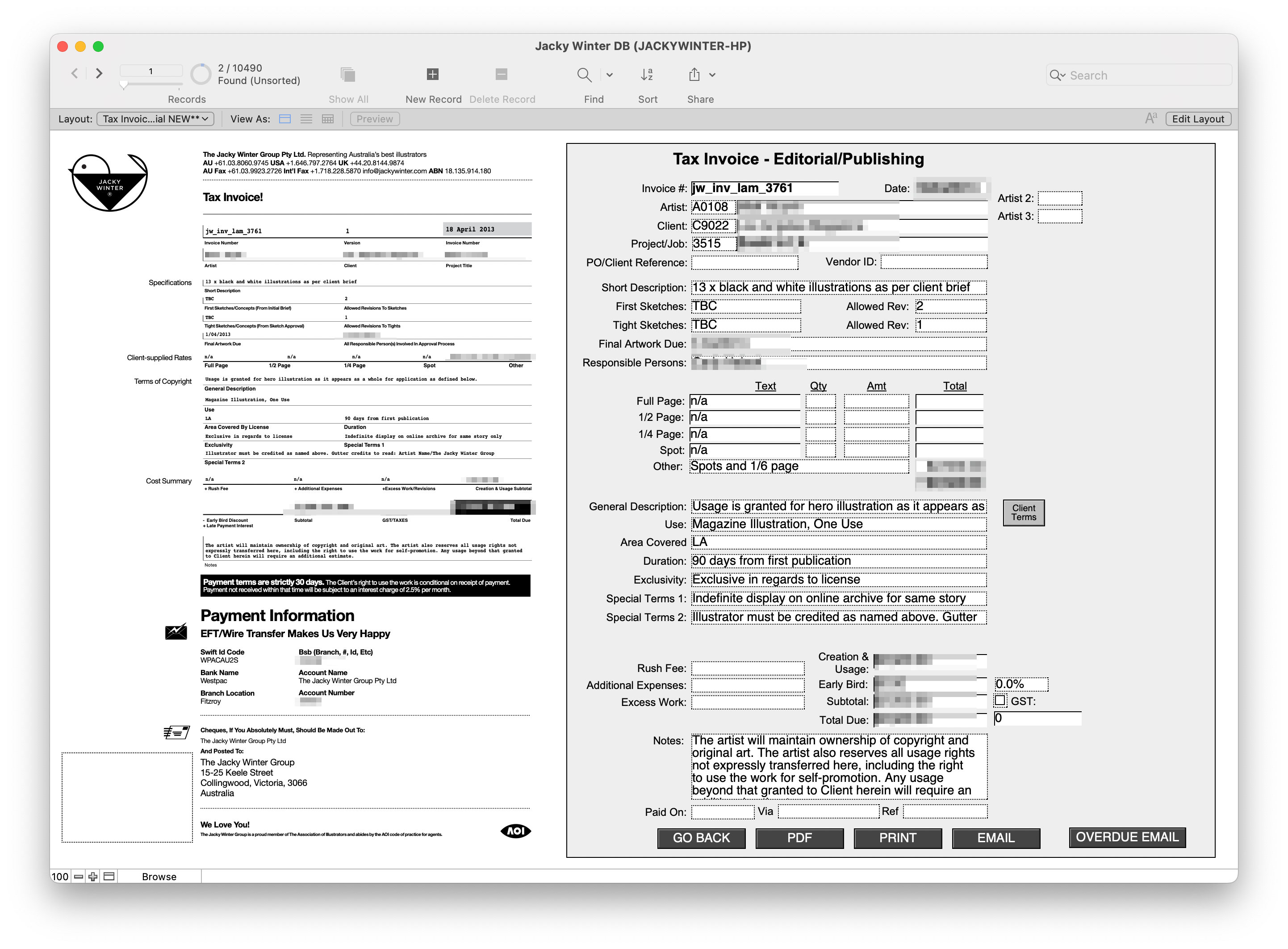
Our paperwork helped us close deals and get taken seriously. We always got great comments on it. It was a point of pride that everything we did and send looked as good as the artists we were fortunate enough to represent. It was a huge point of difference at that time, and as the agency grew we continued to invest in what was now called JWOS and expanded its features based on the needs of our growing team.
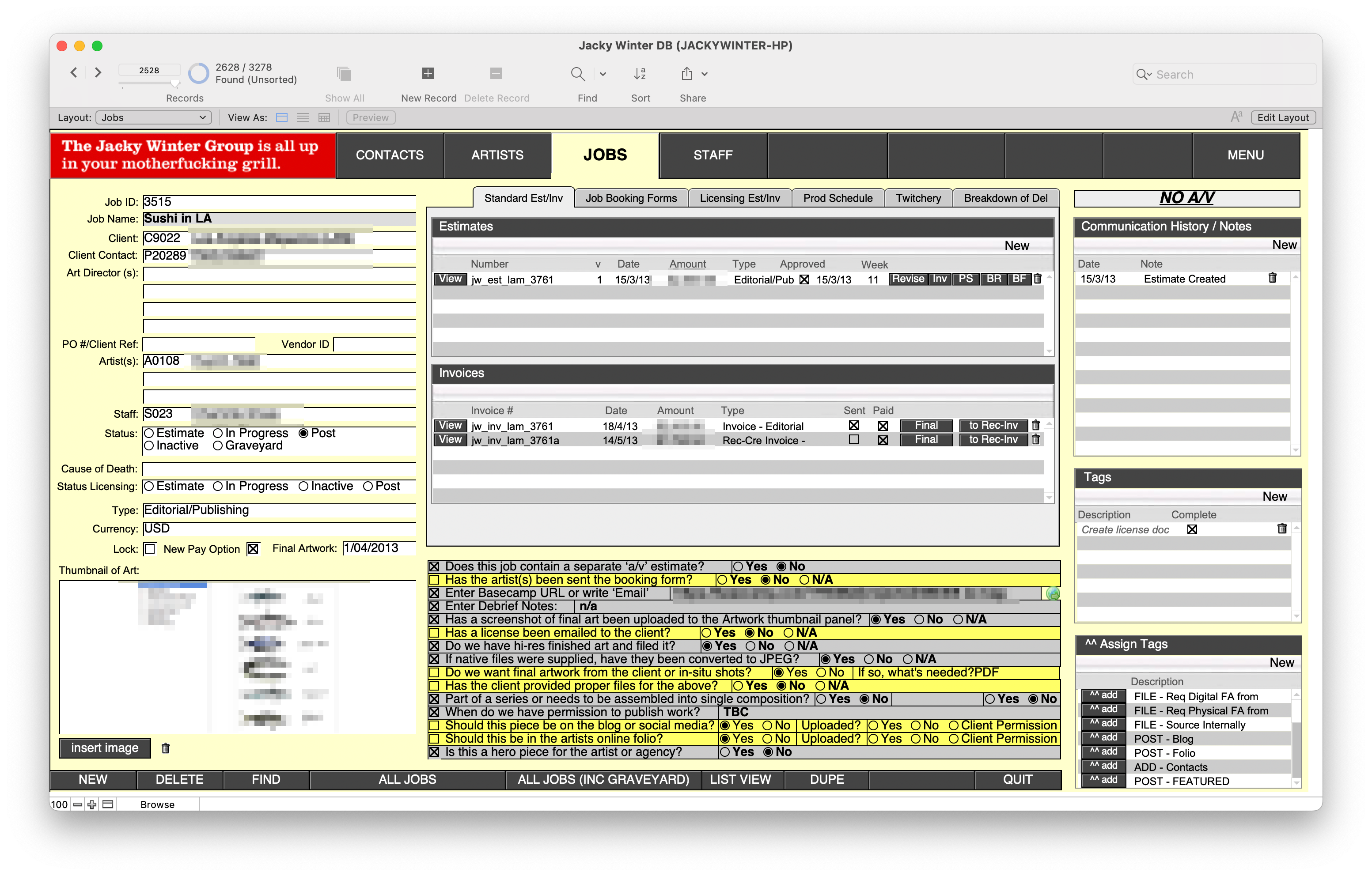
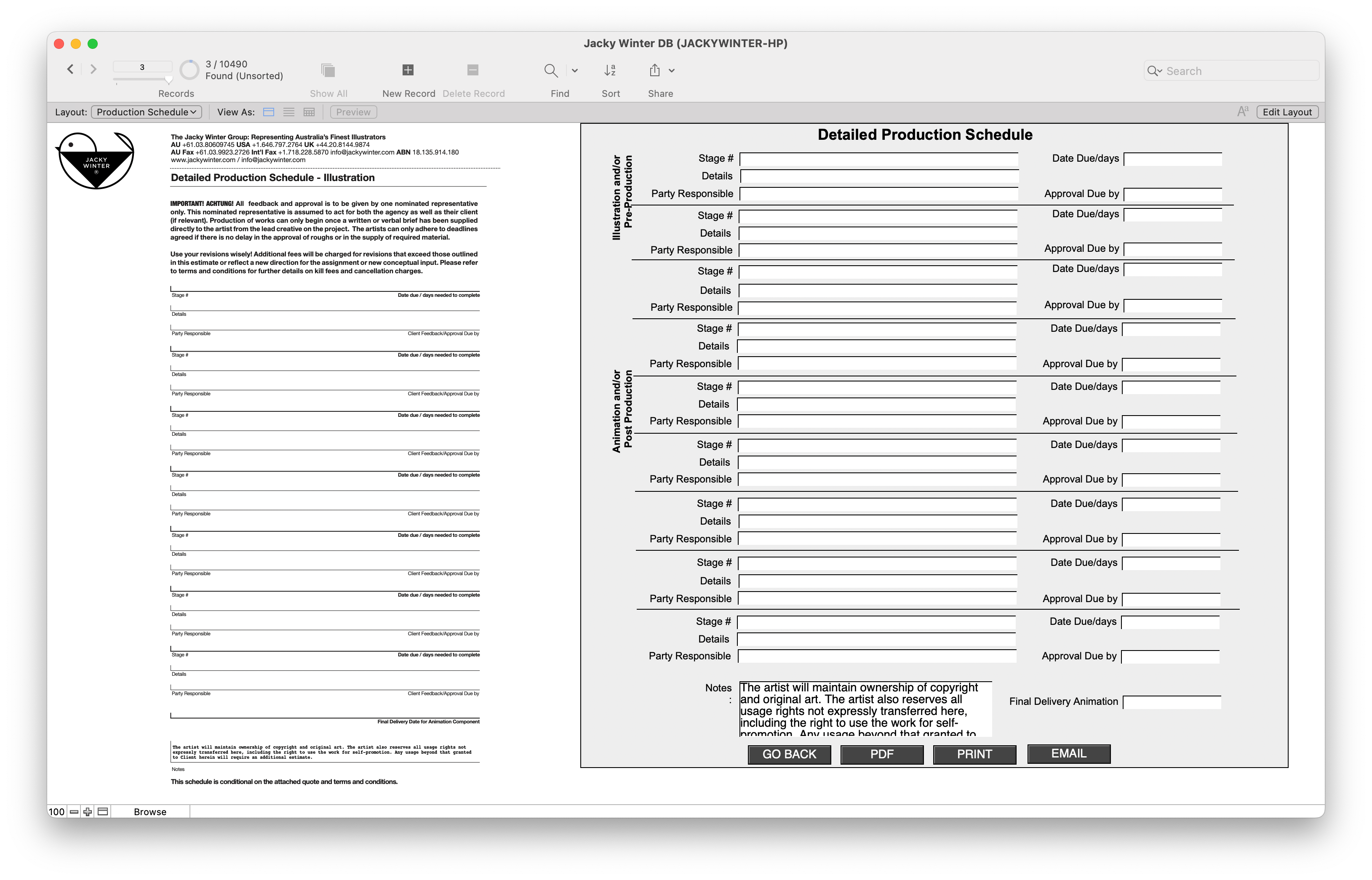
Personally, I also found this a very fulfilling task. For my entire life I have been obsessed with computers and technology, but something about my brain just made it impossible to learn how to code. Similar with art and illustration. I love it. I know what I like, and I know what will be successful, but I can’t do it myself for the life of me. Working with Byron over so many years was in some ways a creative outlet for me similar to what I was doing with Jacky Winter and with artists, but Byron was doing it with code. Even better, because FileMaker is such an agile program that you can quickly iterate on, we were able to make big and substantial changes without the high cost and long timings of more traditional software development. (This is actually a big reason for FileMaker’s ongoing success. In some ways they were one of the first ‘No-code’ software development platforms, and have really leaned into that today as well.)
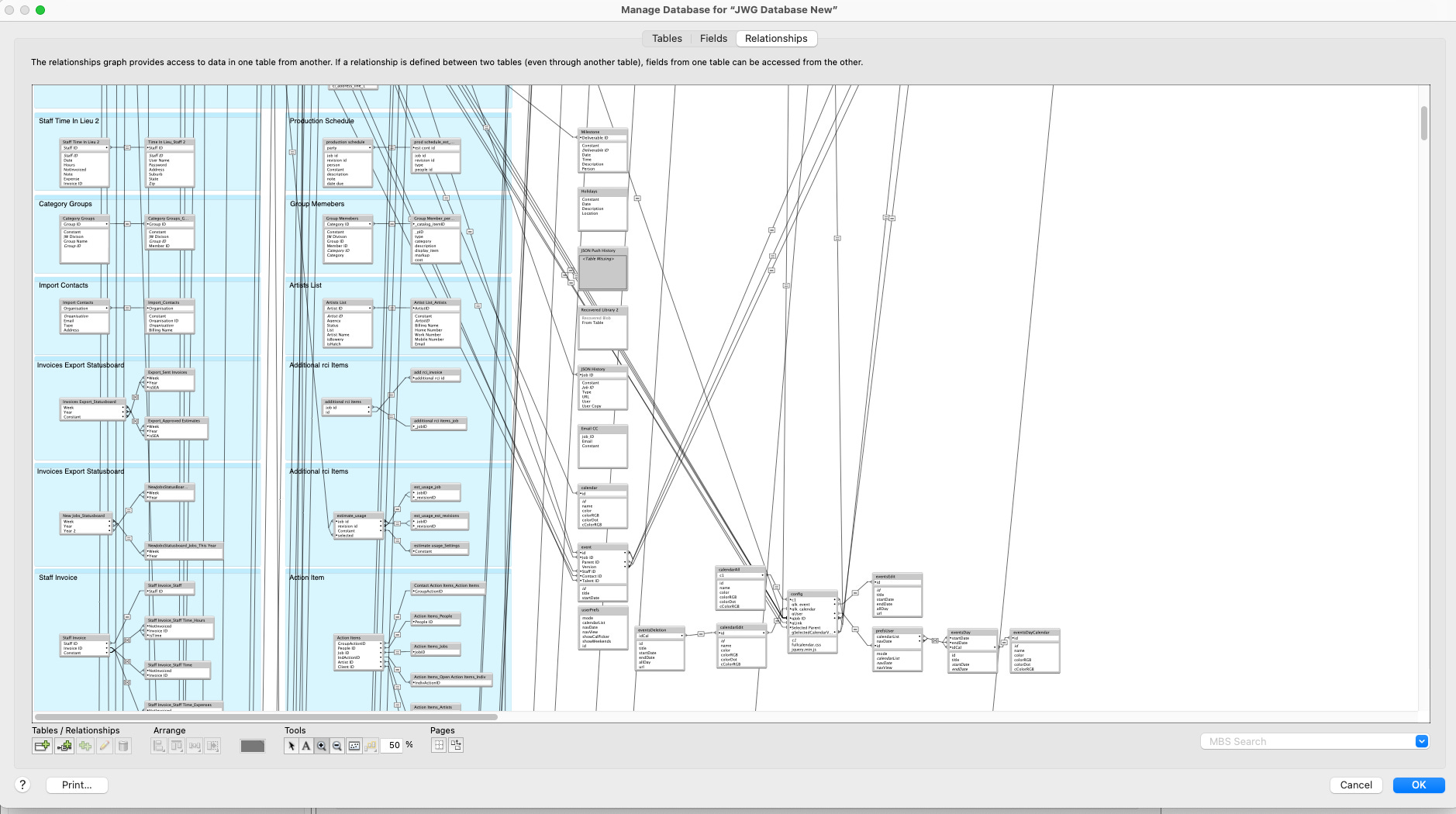
Over time, things got super complicated though. Without anyone to actually put limits on what we could do the app got quite tangled!
It was also at this time however that we started feeling the limitations of where FileMaker could take us. Up to this point the only way you could access the app was if you were in the same physical location. So Basically you had FileMaker server which hosted the app, and then your users all were individual clients which accessed the app from the server. If you were out at a meeting or on the road and wanted to access the app, it was impossible. So we started looking at hosted options that could be accessed from anywhere. As this was before the internet was super duper fast, so we couldn’t really host it locally so we had to find external hosts with faster internet. Even then, because our database was so big, it was really sluggish.
Throughout this time we had also been updating our brand and the general look and feel of the agency, and it’s also around the time where many more online services were popping up. Our biggest tool outside FileMaker was Basecamp, and we loved being able to offer clients this branded and contained experience that was natively digital. Producing jobs through Basecamp was a joy, and we wanted to extend that to the rest of our process.
The seeds were planted at this time to perhaps rebuild onto a web app, and our first port of call was with our amazing friends at Icelab, a local rails shop who had also developed a previous version of our website (and one of our first digital products ever, Slipcase. See also: RIP Notepods, which I will absolutely write about later...).
We began by showing them what we’ve done in FileMaker and asked what would be involved in turning it into a Web App. By this time we had created a bit of a beast - An easy feat in FileMaker that compounded over the years, but it would take the same amount of years to do from scratch at a cost that would be impossible. While that particular idea wasn’t feasible, we were however able to find a different solution, whereby we could replace our gorgeous PDFs with gorgeous Web-based paperwork.
So by putting our FileMaker Guy together with our Web Folks, we rebuilt the app onto the latest version of FileMaker with a new lick of paint, and instead of FileMaker simply overlaying the data from the app onto a PDF template, we were now halfway plugged into a cloud solution where all the data was piped in to a Rails app which would now give our clients a true end-to-end branded experience, with everything from emails to schedules and licenses all looking and feeling great.
With other apps opening their API we were also able to build other bridges with other tools in our suite, such as automatically being able to set up jobs on basecamp and populating it with data from JWOS, as well as pushing invoices and RCIs directly to our new financial platform, Xero. We even were able to build our own primitive dynamic CRM to send out prompts and spreadsheets to keep on top of post-production, as well as a connection to Google to keep all our contacts updated on our phones.
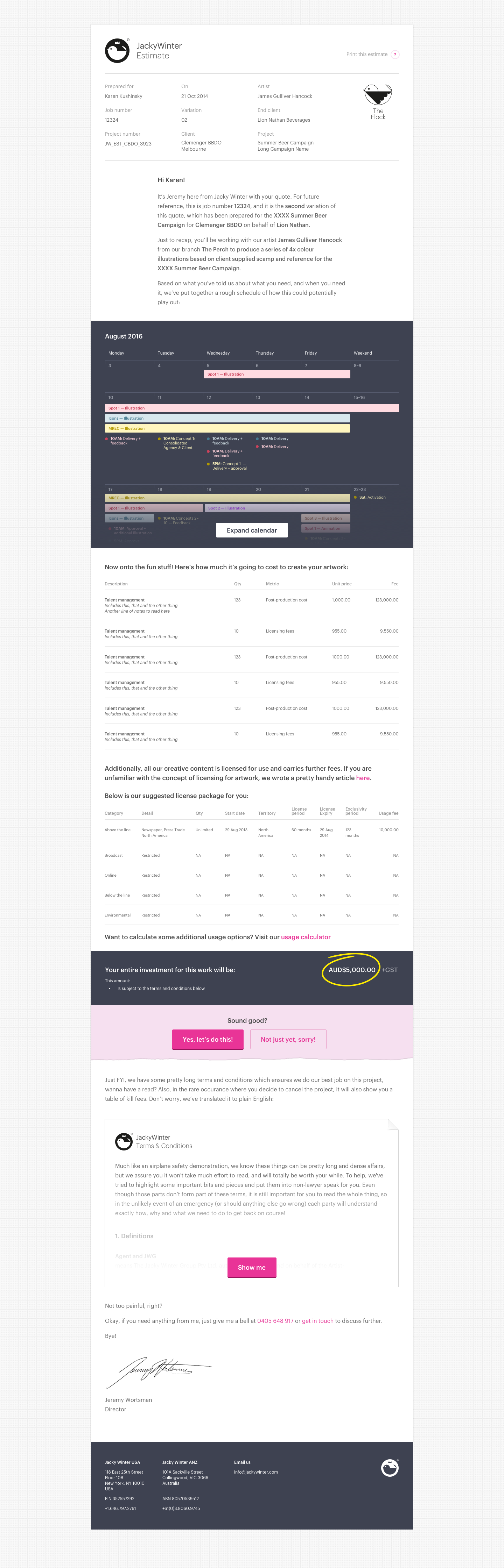
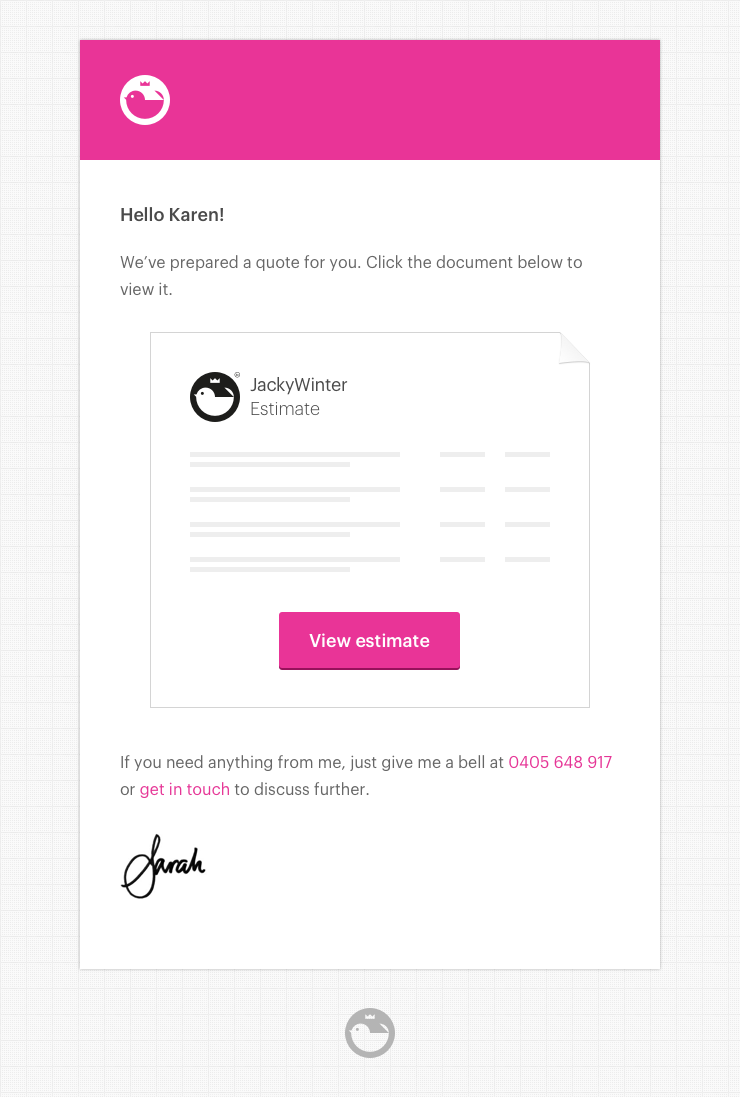





This version of JWOS was really fun and had lots of little touchpoints. Everything from animated gifs in our email headers, to things like onboarding emails with our producer waving to you and a VCF file to get them quickly into your phone book.
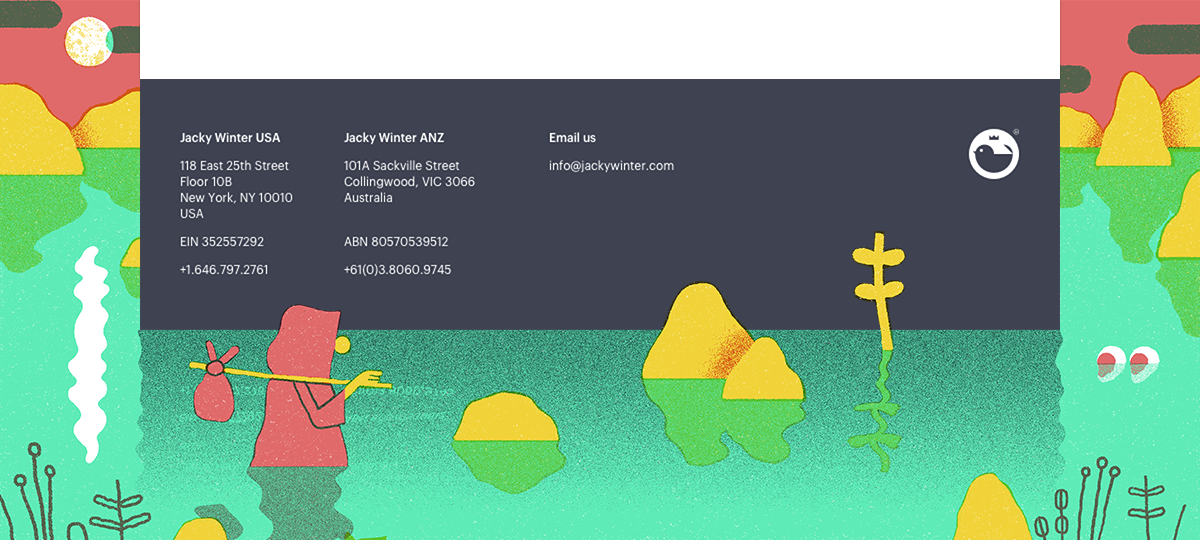
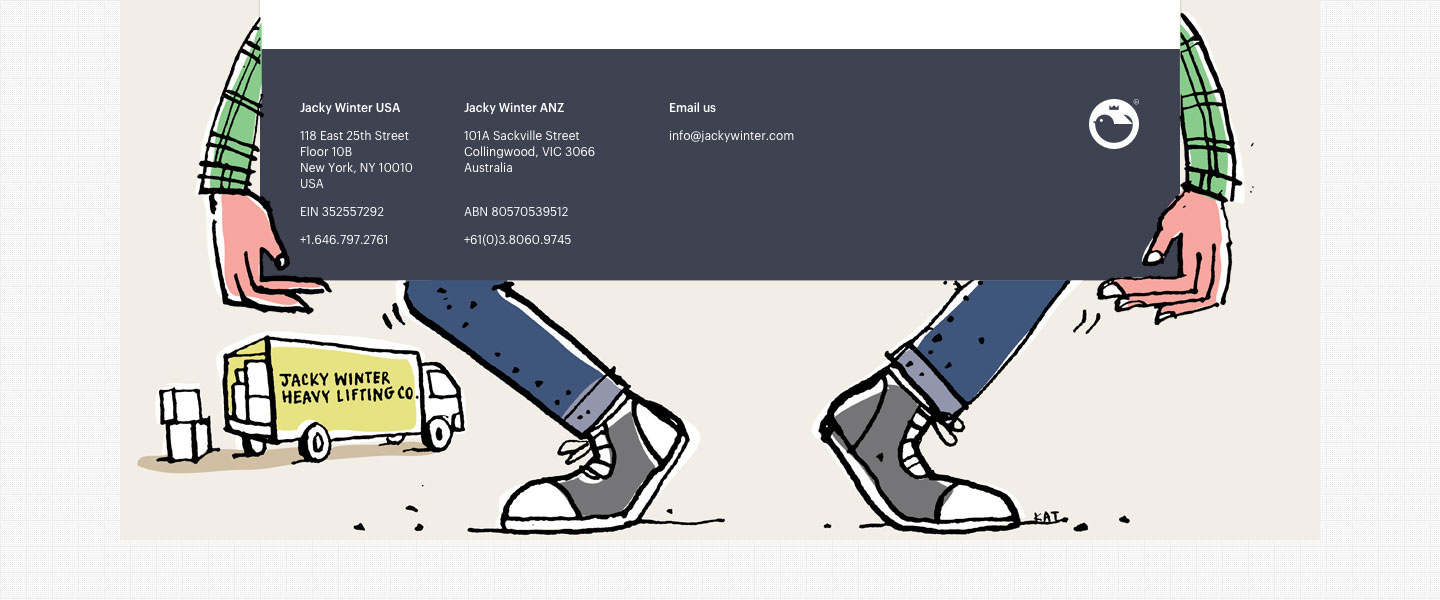
We deployed this new version of JWOS in 2017, right after we established our US office. With a new fibre connection in our Australian office it meant that accessing the app externally was a lot more usable and we were able to migrate away from our external host. As our US office grew however, things got a bit weird. Basically for each staff member who wanted to access the app, they had to have a physical computer in our Australian office that they could connect to. It started with a small HP Mini PC in our server rack, then in 2018 we added a Mac mini on a spare desk. That became three Mac minis in 2019. Then that became three Mac minis with an MacBook Air sitting on top of it in 2020 when we were preparing to open our UK office.
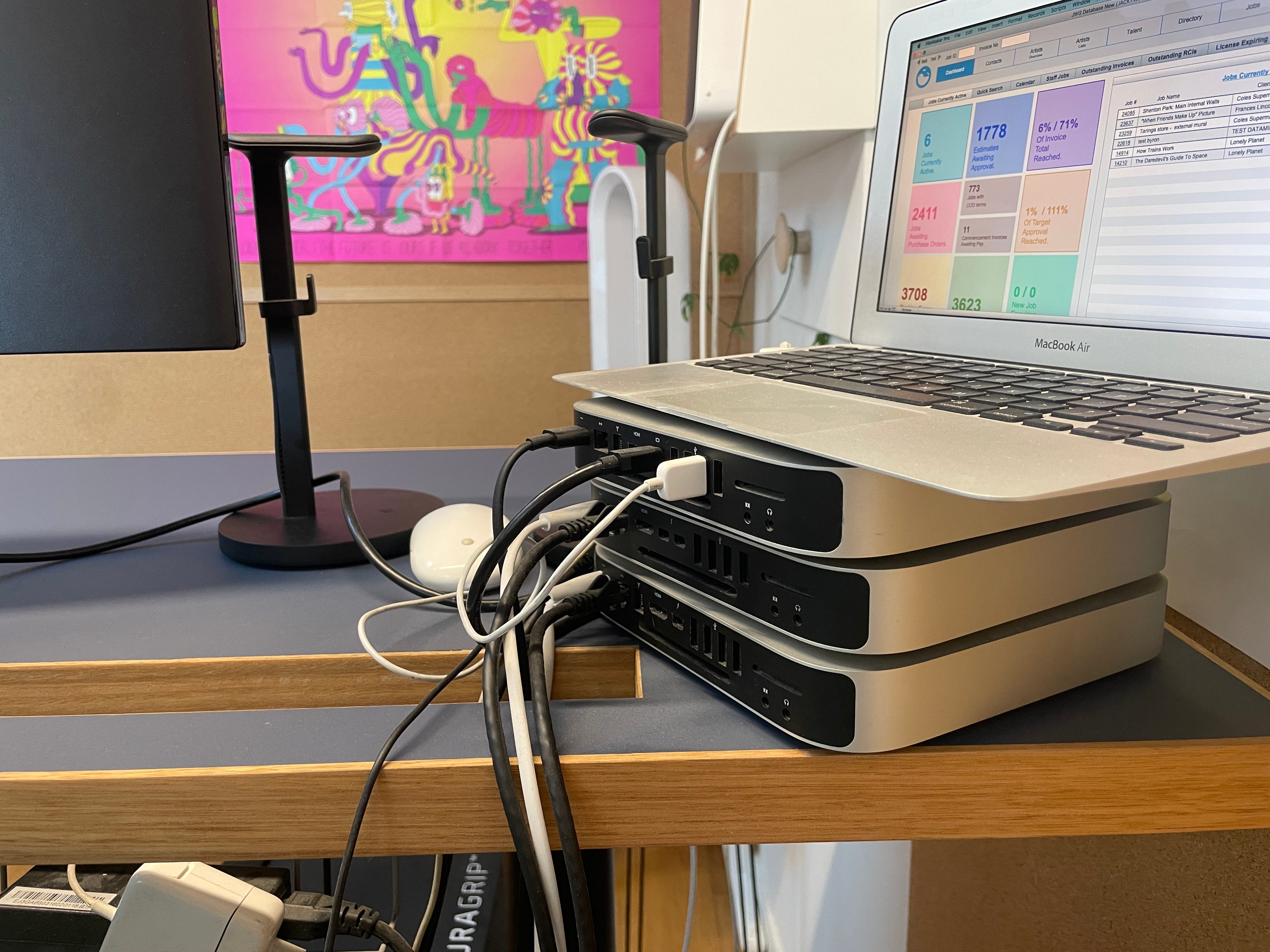
It was an unholy alliance, but it worked. That is until the notorious Golden Plains music festival of 2020 where one person who came back from LA with Covid attended it (along with the entirety of Melbourne). We all left the office early that day, saying we'd see each other again in two weeks, and well you all know the rest of that story.
The shift to working fully remote definitely showed the gaps in our systems. I remember one day our NY office got knocked offline for days because a cleaner accidentally unplugged a power cable to our Mac Minis, and nobody could go and fix it because it was out of our lockdown bubbles.
Picking up early that this shift to WFH was going to be an extended one, I once again did a huge deep dive back into the internet to see what our options are. I looked at Every. Single. Quoting App. I did demos, I did phone calls. I had to endure nearly two hours of someone trying to sell me Salesforce. I contacted existing apps to see if they would do custom development. FileMaker did have this new tech called WebDirect but it wasn't quite scratching the itch.
The main issue was that there was no quoting app that natively supported commissions, which was our second reason for building JWOS to begin with. It's not like we could just whack a line item on a bill and be done with it. Especially when it came to the increasing complexities of jobs we were doing, where one line item might have to get split out to multiple parties. With dozens of jobs on the go across, spreadsheets and manual labour was just not going to cut it.
I knew that now was the time to bite the bullet and to put feelers out to see how/if the technology had evolved and whether a migration to a web app was possible.
I had literally no idea where to turn though or who to ask, when Bianca who runs our NY office shared a newsletter with me about another big website at the time which was run by a small team. The founder was writing transparently about how they built their site and mentioned by name the firm he worked with. At this point I had nothing to lose so I emailed them, explaining I read the article, and wondering what might be possible.
The next day I was on a call, and took the team through JWOS which took a number of hours, but eventually we got a quote back for a MVP which was actually feasible, so we started building from there.
The original process was only supposed to take six months. We started by designing new pages in Figma for every page in JWOS, trying to bring the FileMaker user interactions into a more fluid series of steps with more modern UI touchpoints.


It was at this point I really started to develop a huge respect and understanding of how and why software teams needed to be so large, as the amount of consideration and care that needs to be put into this is so huge.
Once we got most of the front-end built, it was time to re-build those gorgeous templates that Icelab originally designed, and moved them into our updated brand and the expanded feature set.
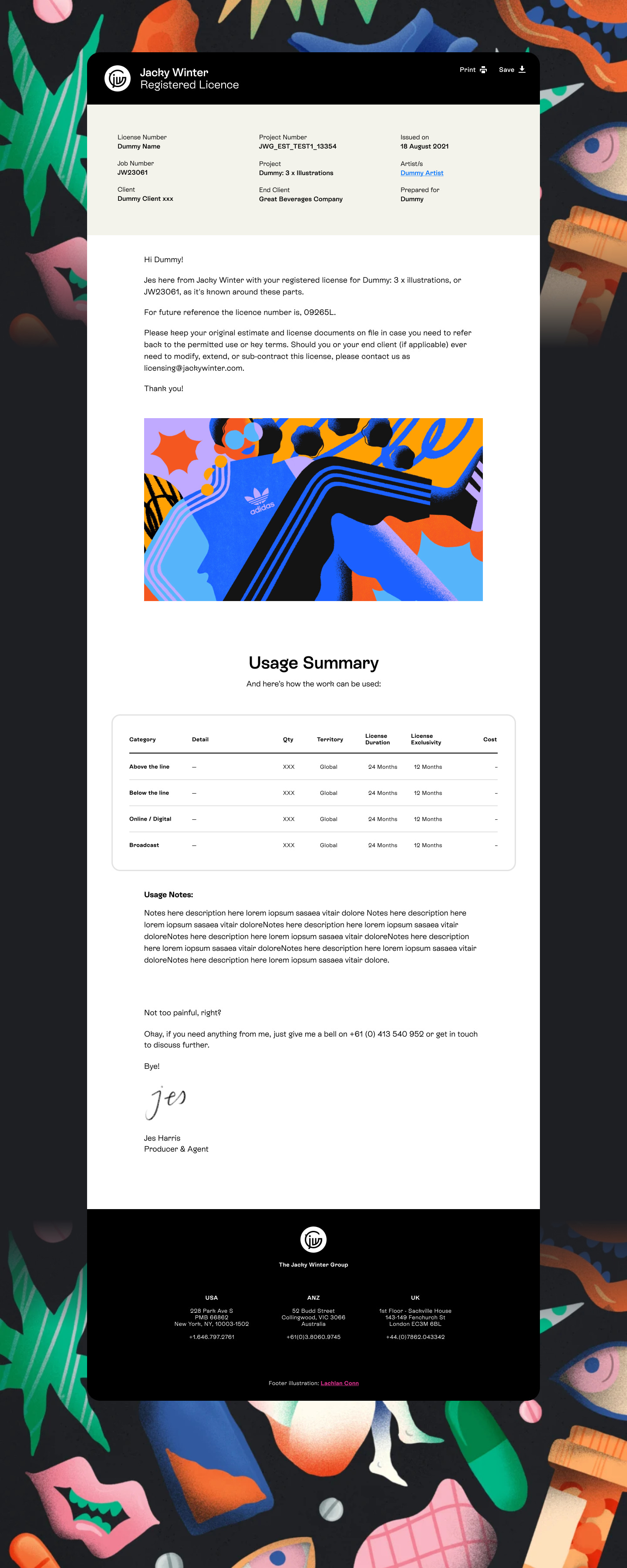
At this point we had pretty much doubled our scope. The platform we chose to build the app on, Ruby on Rails, is quite similar to FileMaker in some ways as it is quite fast to iterate on. Furthermore, our development partners had a big pool of talent to draw on, meaning we could tap into certain specific people and skills when we needed it, and similarly were able to indulge our need for new features which could be used internally.
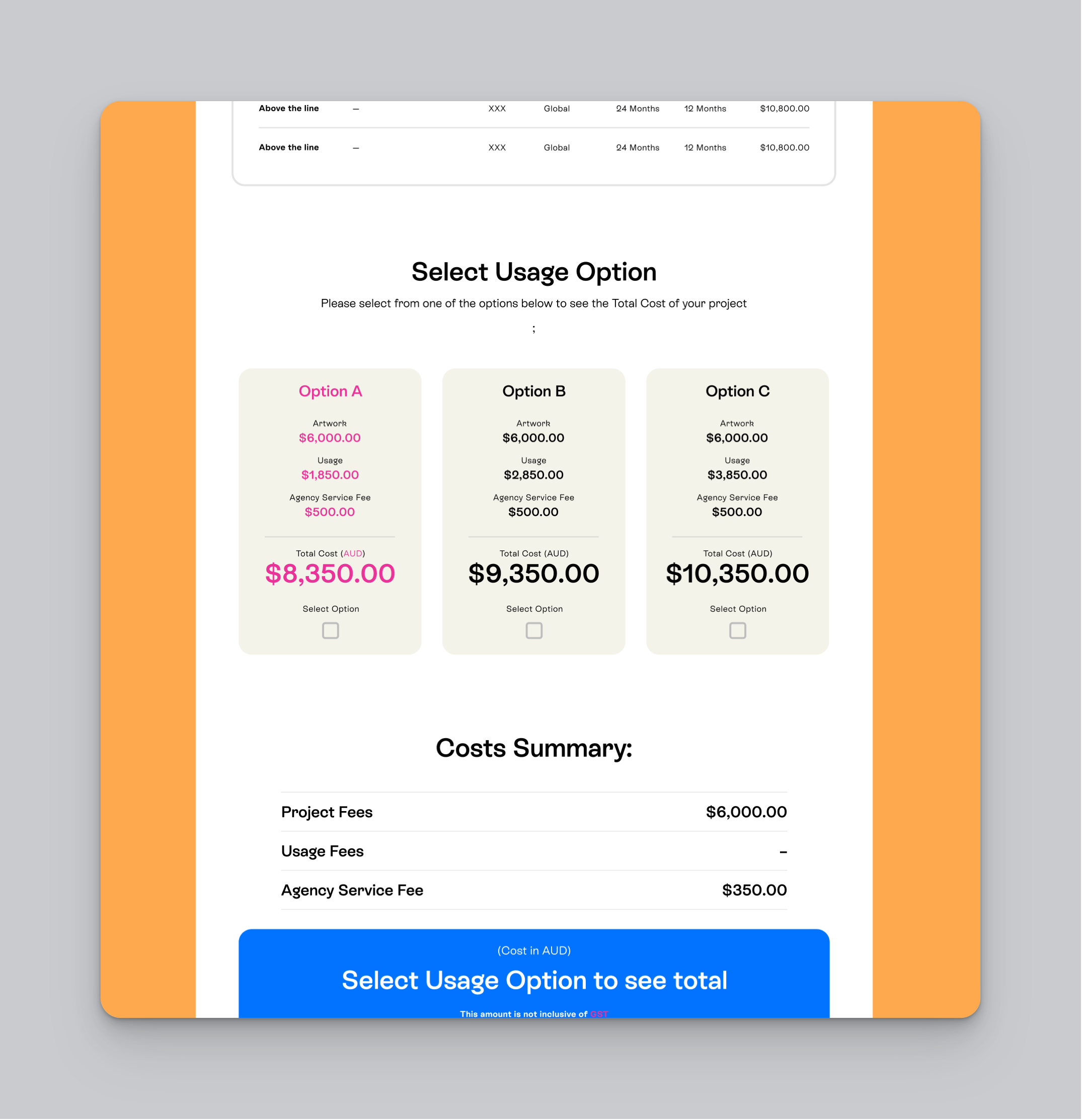
So we were now over a year into the six month project, and had invested quite heavily, also still deep in the Pandemic in the most locked-down city of the world. Fortunately however we were in one of the industries that were not too impacted, and in some ways actually experienced a bit of growth. At the same time, the app was not finished - we were still using FileMaker remotely. It would probably take another year to get things to where I really wanted it at this point, so it was a really tough decision to keep on investing a huge sum of time and money into a product that we would only use internally. At the same time, we were already in too deep.
It was at this point where I was having some deep conversations with a good friend and fellow agent, Rachael Hart who runs the photography agency Hart & Co. She was also running a FileMaker-based custom solution for her quoting system, and I told her what I was cooking up with Cobbler. We discussed the potential of us building out Cobbler so it could work for Photography, and that started us off on a whole new trajectory where we made the decision that we would make the app white-labelled, meaning any other agency could use it.
It was a pretty big call to make. I had (and still have) many reservations on whether other agencies would be trusting to work with us or change their systems to move to something like Cobbler, which was now very much a piece of enterprise software for all intents and purposes. I was a true believer by this point. The app was the real deal, and as we started to experiment using it internally to start fixing bugs and such, the internal feedback was buzzing.
Moving from an internal app to something white-labelled brought among a whole host of new challenges that we are in some ways still working through. Like, we had a whole bunch of hyper-specific features to Jacky Winter that would not be relevant for other agencies. On the flip side, Rachel and her team had many requirements for producing photography work that would not be relevant for us. How did we decide what to prioritise and what to leave on the back-burner?
We were now over two years in, and going deep. Once we had solved most of the hard technical problems, we turned back to the design and realised that the fun and playful JW templates might not be fit for purpose for all studios, so we once again went back to the drawing board and redesigned our templates so they might be a bit more universal.
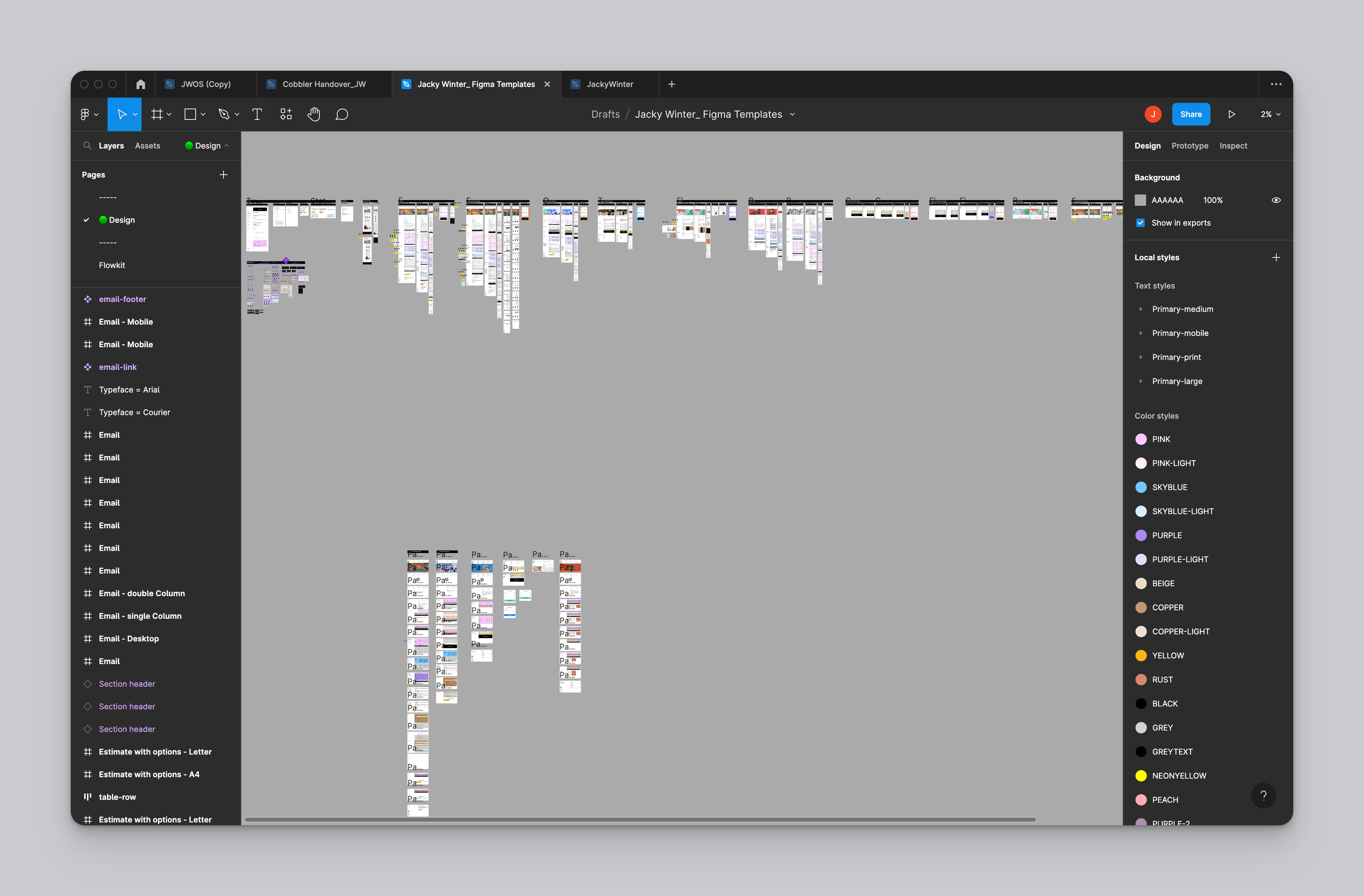
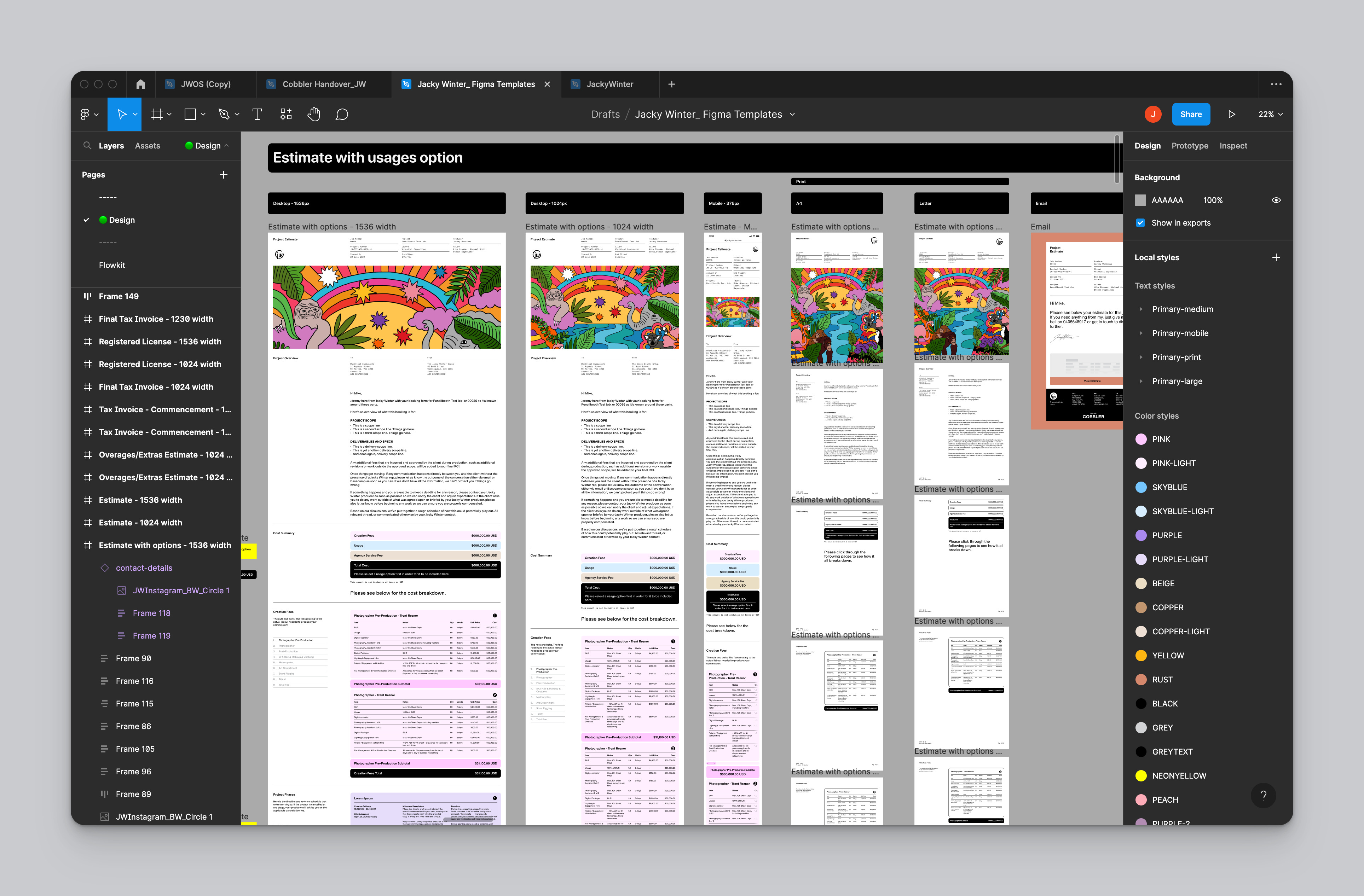
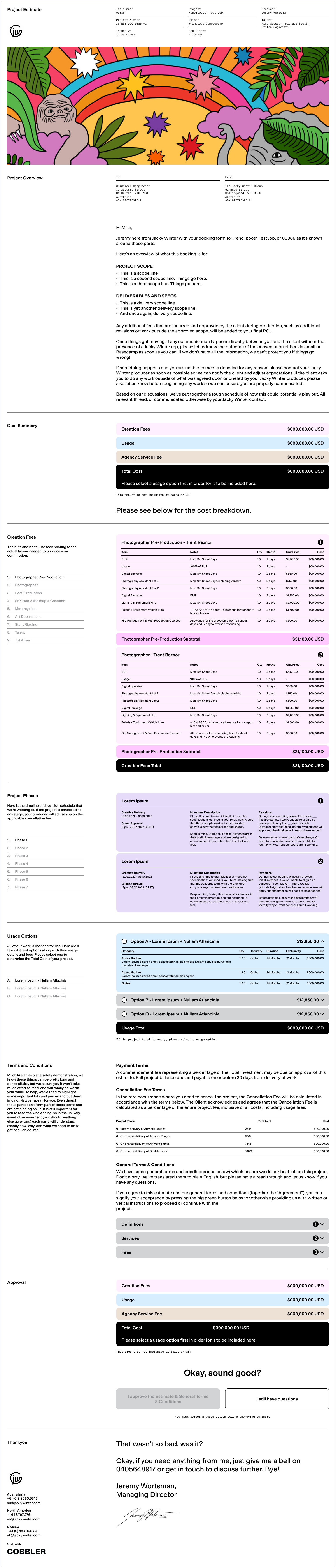
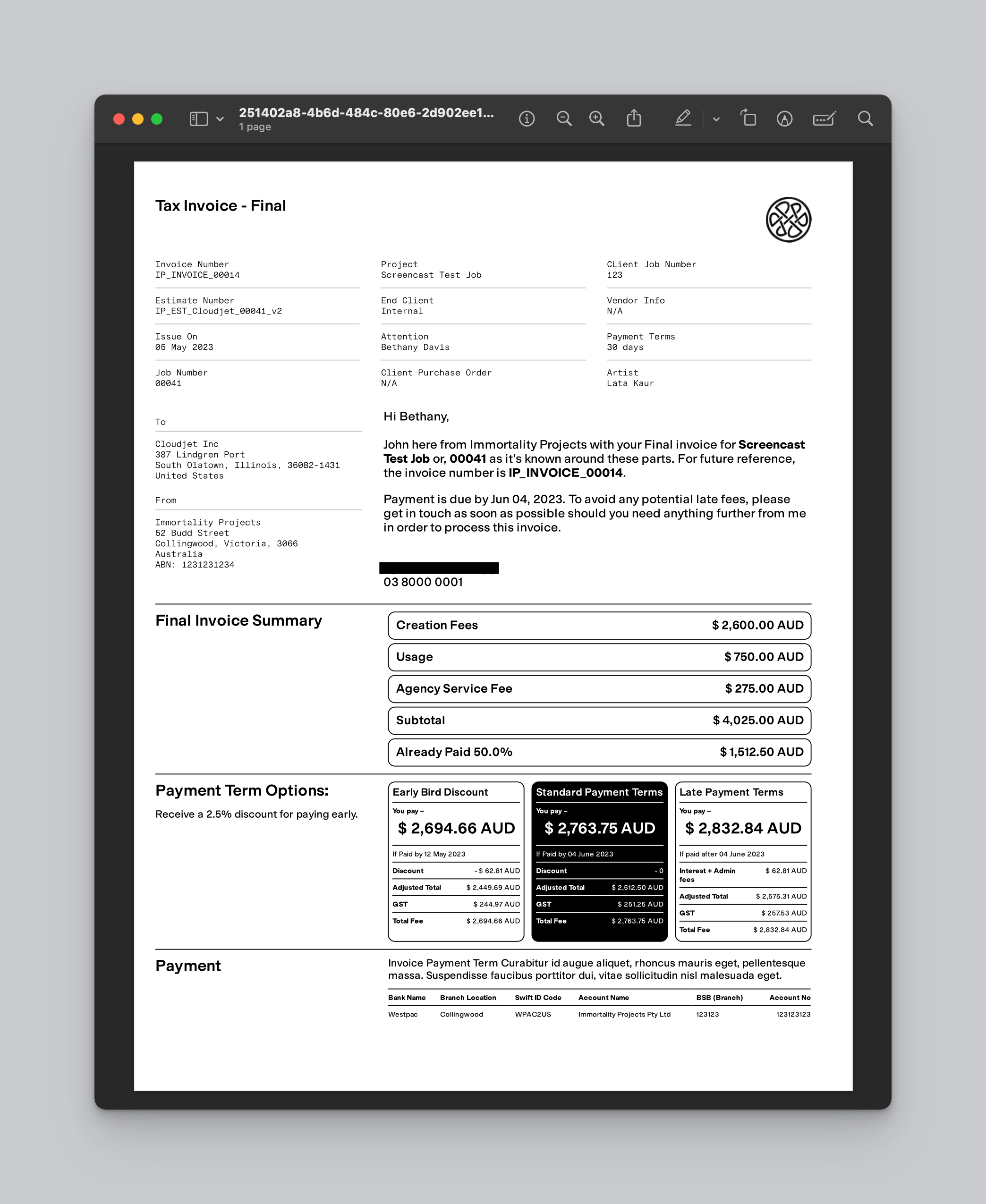
In June 2022 we sent our first estimate from Cobbler. It was a pretty momentous occasion. In the coming months we continued refining the app and now doing a full pass over the UI to bring it more up to date.
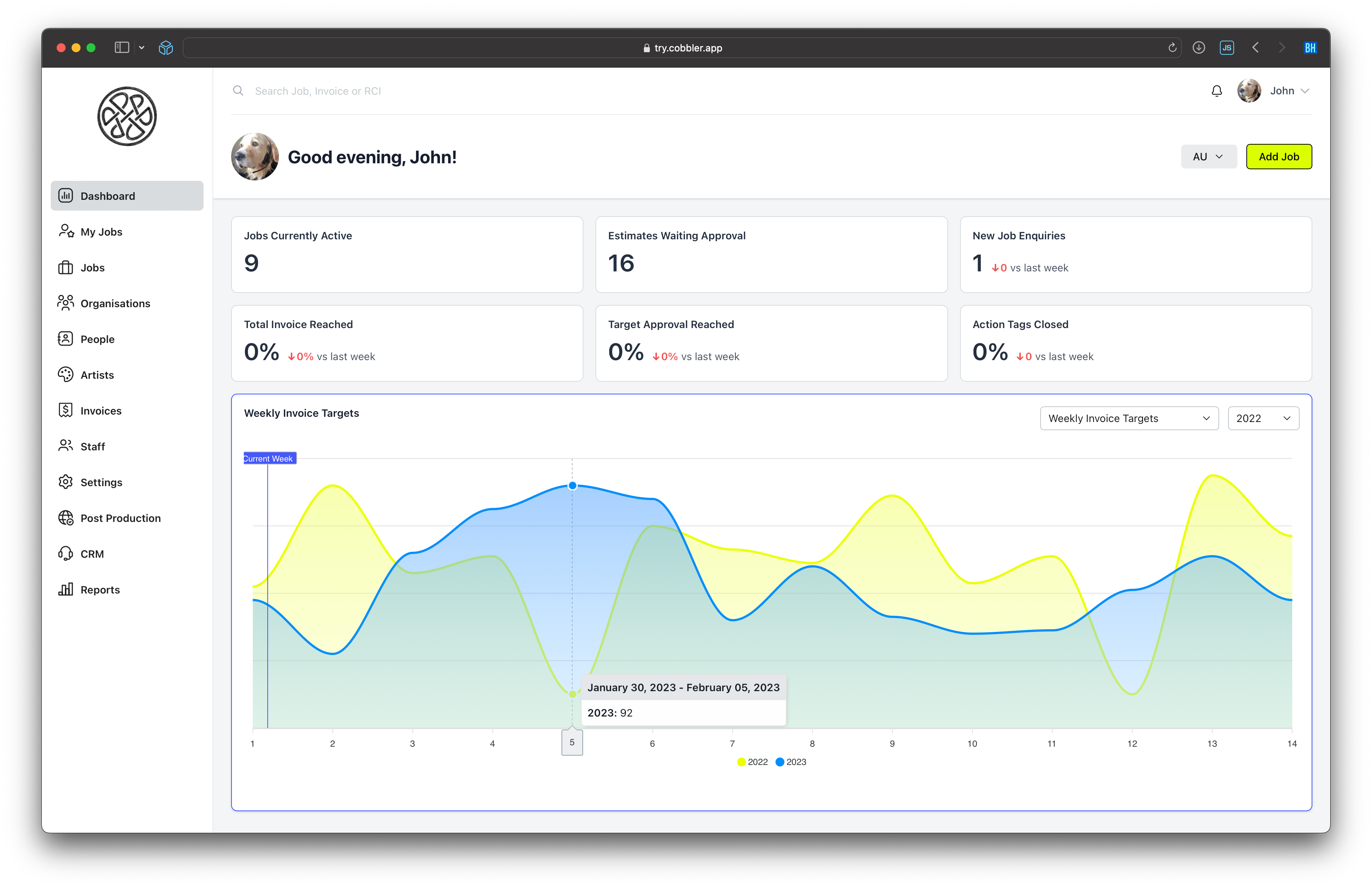
We also started building out our Wishlist to see how we could further integrate other aspects of our work into Cobbler.
We brought concepts from AirBnB's Tyrus into our Milestones Function…
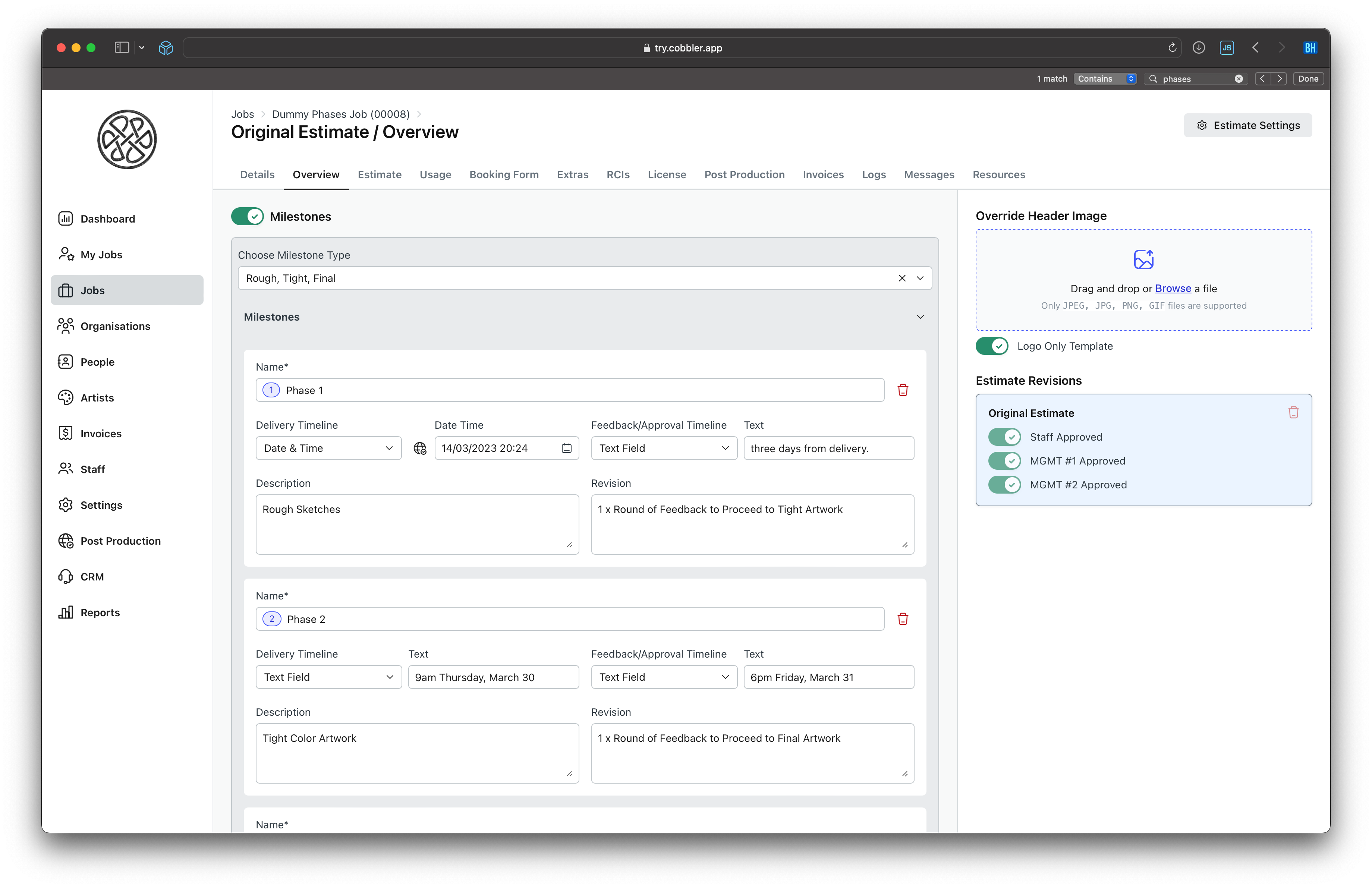
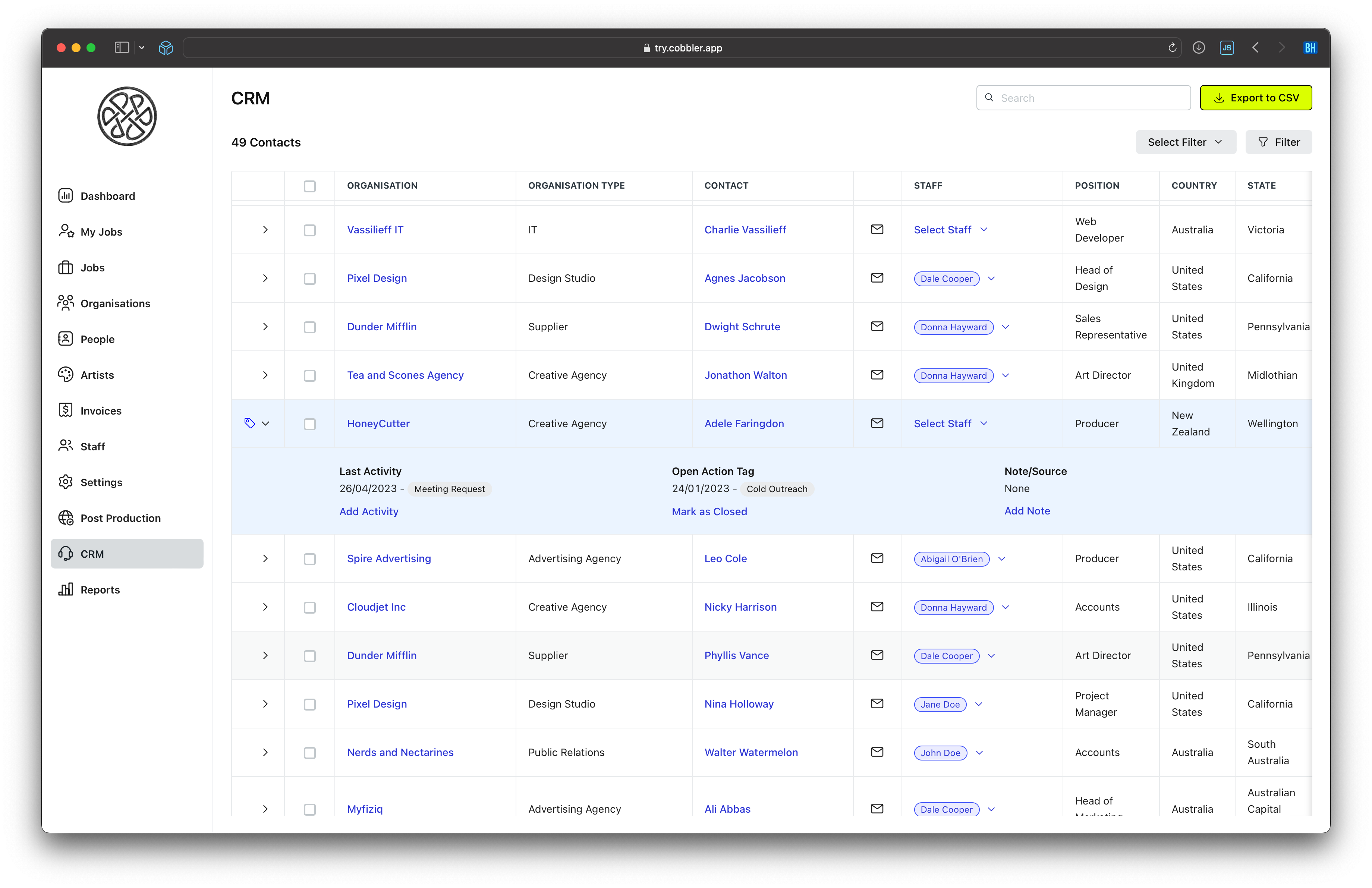
…our complex array of Google Sheets was funnelled into our CRM module.
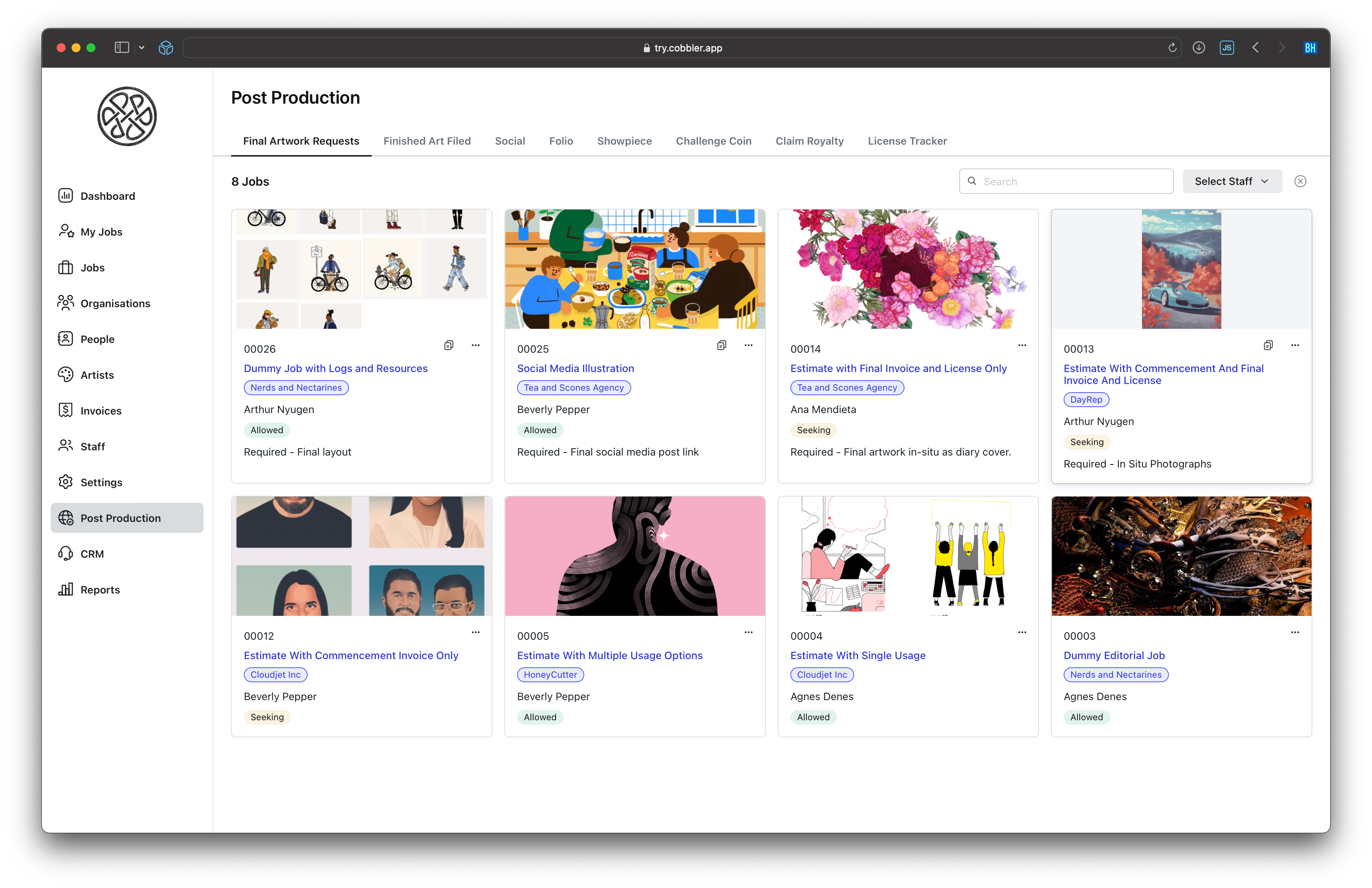
…our overflowing Airtable bases were migrated into a new post production module.
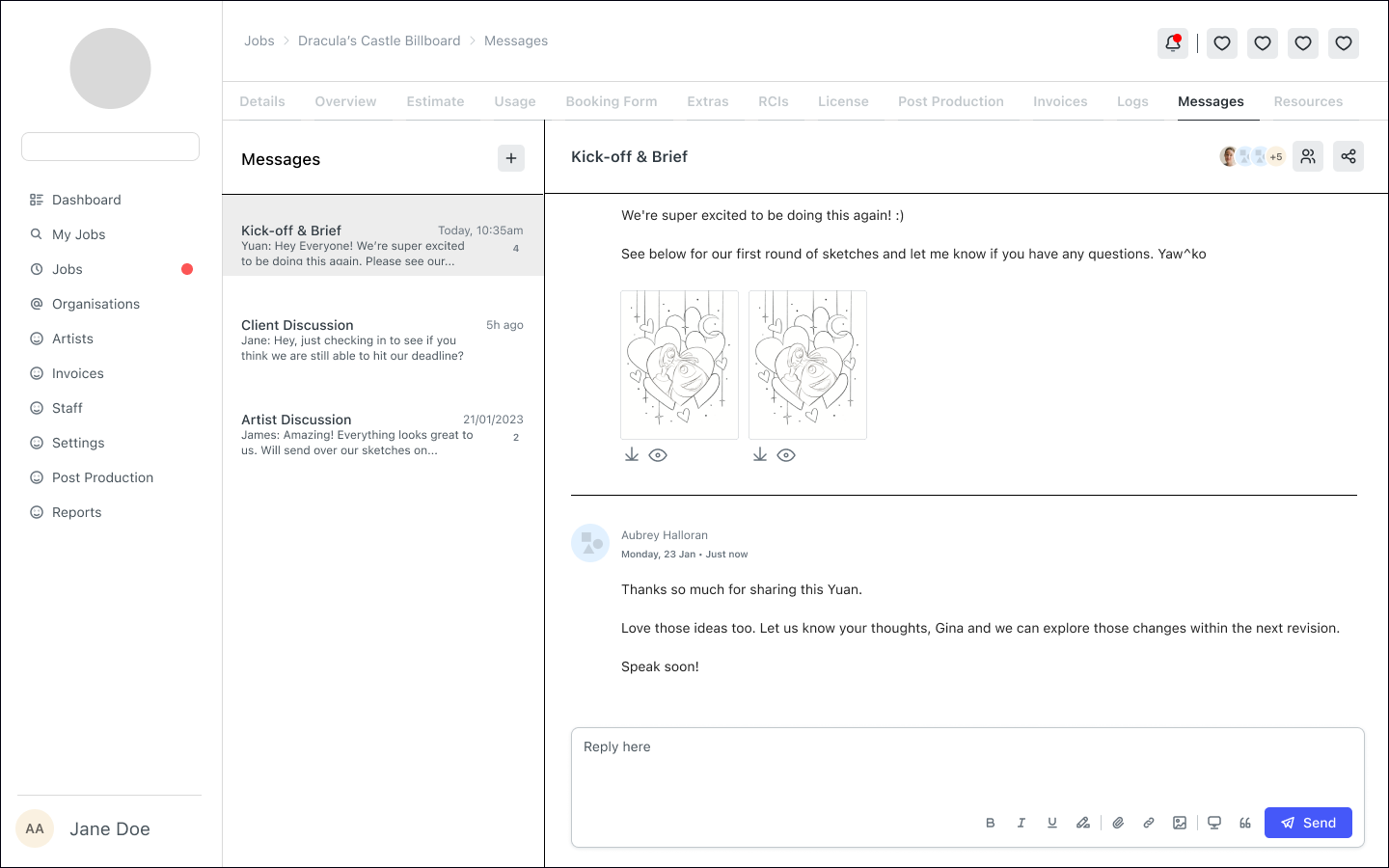
We even decided to ditch Basecamp in lieu of our own chat function.
Each new feature was a new rabbit hole where we could dive fully into and see what the best practices were and how to build them into Cobbler.
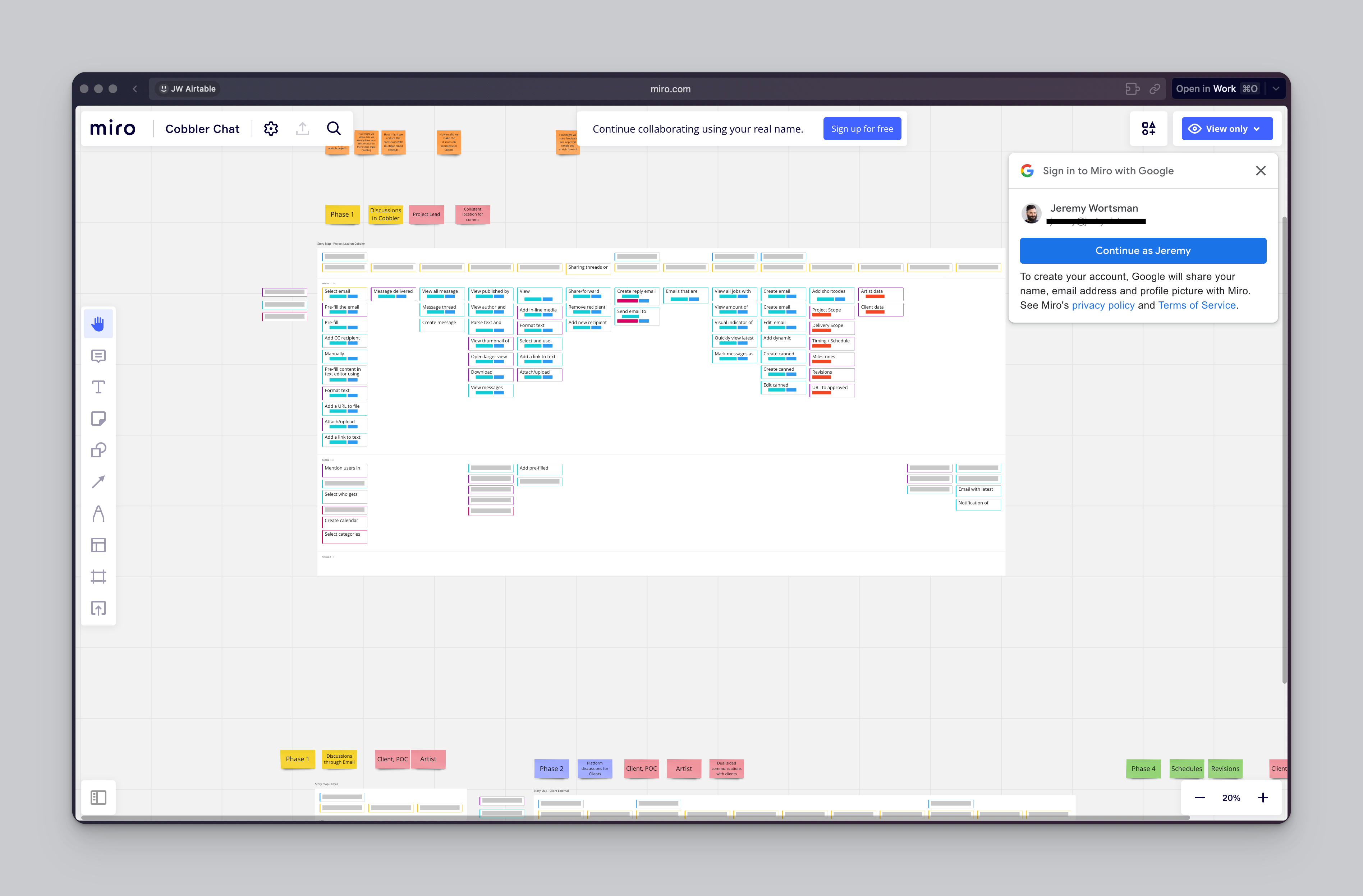
Each of these steps could easily warrant its own separate post. So much has happened behind the scenes and at some point we just needed to call it and get it out there, so here we are!
If you haven't already please do check out the website at cobbler.app and please let me know what you think in the comments bellow. You can also watch this demo which was the twelfth hardest thing I ever have done, and pretty much went as expected.
It's been almost a year to date since our internal launch, and in that time some funny stuff has been happening in that we started getting just random emails of people hearing about the app before we even launched it properly or even spoke about it. We also have been spending lots of time trying to figure out who else could use this. The idea of empowering individual artists or creatives to leverage the tools and systems we've built is a really tempting one, and something still in the works.
We're also actively working on a 'lite' version of Cobbler for design studios and creative agencies who simply want the ability to use Cobbler's ability to send gorgeous paperwork to their clients which I will make a separate post on once we get closer to that announcement.
But yes, that's the long and short of it. 🚀
Personally this has been the third to fourth hardest thing I have ever done in my life, but it's been incredibly rewarding. I have had so many internal conflicts about not truly being a capital C Creative person, so to actually make something like this really does feel magical. I'm only the orchestrator though; there are so many people that need to be acknowledged for their contributions over time, so I also wanted to ensure they all got their full recognition somewhere for the sake of posterity!
Firstly, none of this would be possible without Byron Stone and Datamine Solutions. I've still referred people to him as FileMaker is a very viable platform, even moreso now. Thank you for everything Byron!
Secondly a huge shout out to Icelab for developing our first web bridge, specifically Max Wheeler and Narinda Reeders for humouring me and for all the ongoing support that they should have charged me double for. Extra special thanks to Virginia Murdoch and John McLennan for their ongoing technical advice and emotional support.
BigBinary have been our development partners since day one and have helped realise our vision beyond our imaginations.
Laurie Grattan, Leo Walton, and Mike Geisser all contributed to the front end template designs.
Suzy and Rachel from A Friend of Mine are responsible for the incredible Cobbler website and identity, which was expertly built by the team at Formwork.
Crystal from Apostrophe helped with our copywriting and tone of voice, and Jeff Phillips contributed spot illustrations for the feature list.
Audax Studios filmed our great screencast and Josh Le Good helped with additional animation and editing.
Every Jacky Winter staff member has spent countless hours bug reporting, testing, and submitting ideas. Thank you very much.
And of course, thank you to my wonderful family. And not just because I forgot to include them in this first draft.